The Advantages of a 5 Amp Socket Circuit for Lamps
Niket Kapur • 8 April 2025

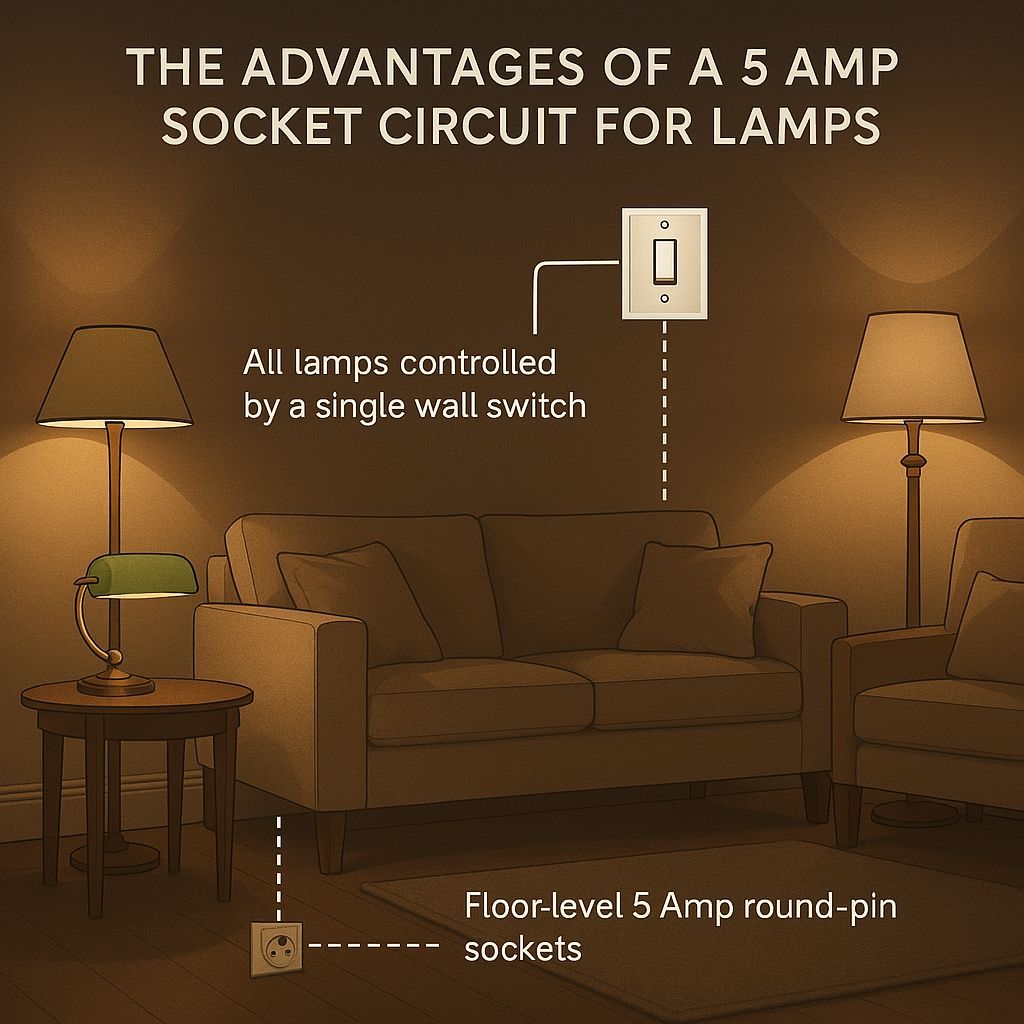
A 5 Amp socket circuit offers a refined and intelligent approach to lamp lighting within the home. Often favoured by competent interior designers, this system uses round-pin sockets, allowing multiple lamps within a room to be controlled from a single wall switch. The result is a more cohesive lighting scheme that is both practical and visually appealing.


Key Benefits:


Convenience and Cohesion: Instead of switching each lamp on individually, a single switch can activate all lamps connected to the circuit. This is ideal for setting the mood instantly when entering a room, or for creating a comfortable, settled atmosphere in the evening.


Design-Led Lighting: Interior designers often specify 5 Amp circuits during the early planning stages, recognising their ability to streamline lamp lighting and eliminate unsightly trailing wires. This contributes to a neater, more curated space.


• Discreet Floor-Level Sockets: These circuits are generally designed with sockets positioned at floor level, rather than on walls. This enables lamps to be placed away from wall corners - perhaps in the middle of a room near a sofa or armchair -  without causing a trip hazard or cable clutter.


• Safer and More Flexible Layouts: This arrangement offers greater freedom in furniture placement, supporting a layout that prioritises both aesthetics and function. It is particularly useful in living rooms, bedrooms, and snug areas where ambient lighting is a key feature.


• Part of a Professional Lighting Plan: A 5 Amp circuit should ideally be considered during the early design phase of a build, extension, or refurbishment project. This allows it to be properly priced within the tender process and coordinated with other electrical work and furniture layouts.


In summary, a 5 Amp socket circuit brings together elegance, functionality, and ease of use. Competent interior designers use this system to create lighting plans that feel seamless and intuitive. For homeowners embarking on a new build or renovation, it is worth exploring this option to achieve a warm, well-thought-out environment.

by Niket Kapur 20 March 2026
A homeowner commenced building works on their property without arranging appropriate site insurance. This is not uncommon. There is often an assumption that either the contractor’s insurance will be sufficient, or that an existing household policy will continue to provide cover. In this case, neither applied. Partway through the project, it became clear that there was no valid insurance in place. At that stage, the position became significantly more difficult. Insurers were unwilling to provide cover retrospectively. From their perspective, the risk had already begun without protection, and they were being asked to step into an unknown position. The property was effectively uninsured during an active construction project. We were instructed to review the situation. A structured approach was taken, including: Clearly defining the scope and stage of the works Presenting the risk in a transparent and credible way Engaging directly with specialist insurers Following extensive discussions, we were able to: Secure appropriate site insurance cover Bring the project back within an insurable and protected framework This was not straightforward. It required persistence and a clear understanding of how insurers assess risk. On a construction project, the absence of insurance is not a minor oversight. It is a significant exposure. If you are planning a build, it is worth ensuring that the right cover is in place before work begins. 
by Niket Kapur 20 March 2026
A homeowner commenced a significant renovation project with the intention of improving and extending their property. The project did not proceed as expected. There were delays with planning, and during the course of the works, structural issues emerged which required a reassessment of the build. Ultimately, a substantial part of the property had to be demolished mid-project. At this stage, the property was clearly uninhabitable. However, the local authority took a different view. They imposed double council tax on the basis that the property was empty, applying the standard premium used to discourage long-term vacant properties. Representations were made to explain the position. These were rejected. The authority maintained a rigid stance and would not accept that the condition of the property and the nature of the works justified relief. The charges continued to accrue. We were instructed to review the situation. A detailed and structured approach was taken, including assembling the appropriate evidence, reframing the basis of the claim, and engaging with the local authority in a more targeted way. The outcome was clear: Full council tax waiver achieved Over £10,000 recovered for the client Ongoing liability removed This is not an uncommon scenario. Local authorities will often apply standard rules without properly considering the specific circumstances of a construction project. Initial refusals are frequent, but they are not always correct. A properly prepared and presented case can materially change the outcome. Situations like this arise regularly on construction projects. Addressing them correctly can make a significant financial difference. Sunil K Radia The Building Guidance Partnership Telephone (020) 8076 3110 WhatsApp +44 7507 705376 www.theBGP.co.uk
by Niket Kapur 20 March 2026
Most homeowners focus on design, finishes and cost when undertaking a building project. Very few focus on compliance. That is where serious problems arise. This note sets out the key regulatory and risk areas that are frequently overlooked. These are not minor technicalities. They are issues that can expose you to financial loss, uninsured risk and legal liability. 1. Notifying Your Mortgage Lender If your property is subject to a mortgage, your lender has a legal charge over it. That property is their security. Most mortgage terms require you to notify the lender before carrying out structural works Some lenders require formal consent Failure to notify can place you in breach of your mortgage conditions This is often ignored. It should not be. 2. Insurance During Construction Standard household insurance is usually not valid during major renovation or structural works. Many policies specifically exclude properties under construction Continuing without appropriate cover can leave you completely exposed You should: Notify your existing insurer before works commence Arrange specialist renovation insurance where required Ensure cover includes fire, flood, theft, vandalism and public liability Do not assume you are covered. Check. 3. Contractor Insurance Is Not a Substitute Many homeowners assume the contractor’s insurance will protect them. That assumption is dangerous. You must verify: The level of cover is sufficient for the scale of the project The policy includes public liability, employer’s liability and contract works Cover extends to damage to neighbouring properties Liability includes injury to third parties, including trespassers Do not accept a certificate at face value. Review the detail. 4. VAT: Getting It Wrong Is Expensive VAT treatment in construction is complex but critical. New builds may qualify for 0 percent VAT Properties empty for two years or more may qualify for 5 percent VAT on renovation works Evidence of vacancy is essential and must be properly assembled Failure to structure this correctly can cost many thousands of pounds. 5. Council Tax on Uninhabitable Properties Where a property is genuinely uninhabitable, relief or exemption from council tax may be available. In practice: Applications are often rejected at first instance Local authorities do not always guide applicants through the correct route A structured and informed approach is required to secure the correct outcome We regularly assist clients in securing substantial savings, including backdated recoveries where appropriate. 6. Site Safety and Residual Liability Even when a contractor is in possession of the site, the homeowner can still carry risk. If someone is injured on site, including a passer-by or trespasser, liability may arise Simply appointing a contractor does not remove your exposure You should ensure: Proper site security is in place Risk assessments and method statements are being followed Insurance arrangements align with the actual risks on site This is not theoretical. Claims do arise in these circumstances. Final Thought These issues are rarely considered at the outset, yet they carry real consequences. Getting them right early avoids problems later. Contact us today so that we can review your arrangements.  Sunil K Radia The Building Guidance Partnership Telephone (020) 8076 3110 WhatsApp +44 7507 705376 www.theBGP.co.uk